America Has Worn Out Its Shock Absorbers
Since 2008, fiscal policy has served as the macroeconomic shock absorber, taking over from monetary policy, and it has done the job remarkably well. The flip side is that public debt has quadrupled, passing $40 trillion, while long-term rates have climbed back up. Under those conditions fiscal stimulus is expensive, and we should therefore expect sharper economic and financial cycles.
Three trajectories, three stories
Measured in dollars, the trajectory of US public debt tells the story of a country that always spends more, whatever the colour of the party in power. A country that does not control its public spending, but has never had to: with the dollar as the world's reserve currency, demand for its debt has always been there and rates have stayed low.
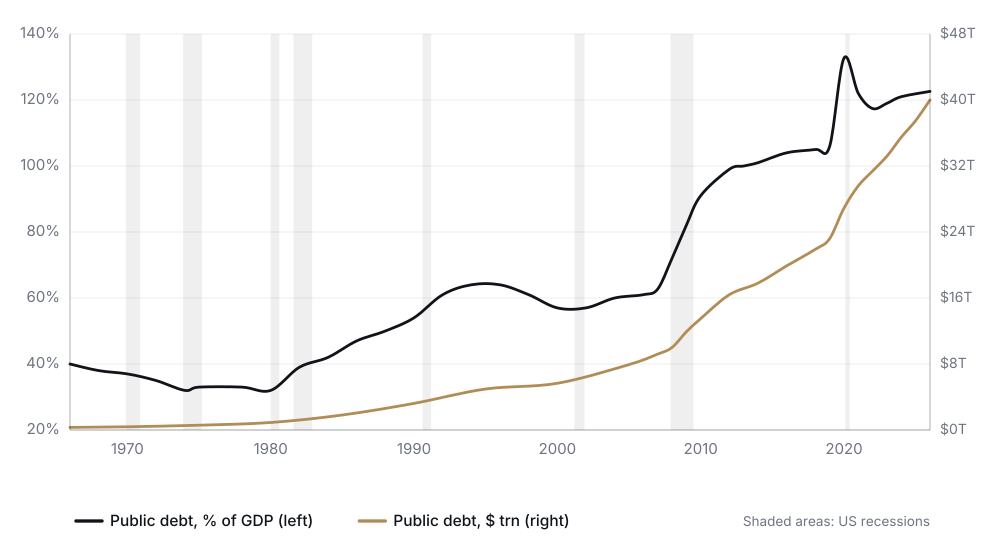
Measured as a share of GDP, the trajectory becomes more nuanced: it does not always rise. After Covid, the US debt ratio fell from 132.7% in the second quarter of 2020 to 117.4% by mid-2022, before climbing back to 122.6% today. The denominator works too.
Set against recessions — the shaded areas in Chart 1 — it tells a third story, and the most interesting one. Public debt rises during contractions: it is countercyclical, and that function has become more pronounced since the financial crisis of 2007-2008, the 2020 jump being its caricature.
Fiscal stimulus has become expensive
Just before the subprime crisis, US public debt stood at $9.2 trillion, less than a quarter of today's level, and at 62.7% of GDP, roughly half of today's ratio — an enviable position that offered considerable room for manoeuvre.
According to the Government Accountability Office, the most recent fiscal response, to Covid, mobilised $4.6 trillion. We do not know what that policy cost to fund, since there is no such thing as a Covid bond. But taking the US ten-year yield as the benchmark, the annual interest charge on such a programme came to some $30 billion in 2020, when the rate stood at 0.65%. At today's 4.69%, the same programme would cost $216 billion a year, on top of the roughly $1 trillion in net interest the United States will pay in 2026. Seven times more for the same shock absorber, and a 20% increase in the interest bill. Nor is 4.69% in any way exceptional: it is exactly the level of spring 2007, before the crisis. It is not today's rate that is abnormal, it is the decade that followed 2008.
Two constraints that are no longer independent
At 3.50-3.75%, the Fed's policy rate offers more than three hundred basis points of conventional room to cut, more than in 2019 and beyond comparison with 2015. Central banks are no longer short of ammunition. What has changed is that the two instruments — monetary policy and fiscal policy — are no longer independent.
During the Great Moderation, a demand shock called for a rate cut that stabilised activity and inflation at the same time: monetary policy was a free option, and it incidentally made the deficit cheaper to carry. With inflation at 3.7% and shocks now coming from the supply side — tariffs, energy, the fragmentation of supply chains — the same cut supports activity while worsening inflation, pushing long-term rates higher and making more expensive the very debt it was meant to render financeable.
The trade-off no longer concerns the calibration of an instrument, but two objectives that have become incompatible. No amount of ammunition resolves a trade-off.
The return of exchange rates
How will the next cycle be smoothed, how will the consequences of the next crisis be absorbed? Most probably through the exchange rate. This is Milton Friedman's old lesson: when domestic prices are rigid and policy instruments constrained, the exchange rate is the price that adjusts fastest. A country that can no longer absorb a real shock through its budget or through its rates absorbs it through its currency. We should therefore expect currency movements on a scale forgotten since the 1980s — not between all currencies, since the constraint is widely shared, but between the blocs that genuinely differ: debtors against creditors, countries with no room for manoeuvre against countries that have kept some. In that context the Swiss franc should continue to appreciate over time, and to jump during crises in countries with weaker fundamentals. The same holds for means of exchange outside the financial system, such as gold and bitcoin.
The end of a parenthesis
We are leaving a forty-year parenthesis during which macroeconomic stabilisation was cheap and near-automatic. It is becoming expensive and discretionary again. Coming shocks will therefore be felt more forcefully, in the economic numbers as much as in asset prices: call it the Great Resonance, by symmetry with the Great Moderation that has now ended.
For a portfolio, the consequence is less bleak than it sounds. A world in which the state absorbs less is a world in which volatility returns across countries, across currencies, across strong and fragile balance sheets. Portfolio stability was subsidised by governments for a long time. From now on, we will have to build it ourselves.
This article was originally published in French on Allnews.ch. Deutsche Version.
← All publications