The Myth of China's Slowdown
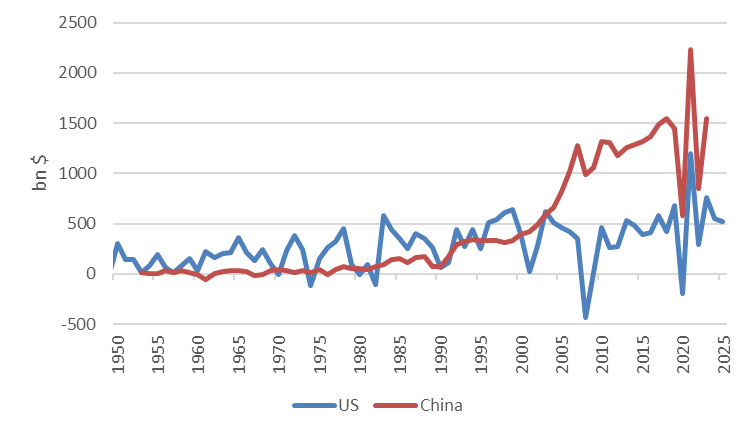
The latest growth forecasts for the Chinese economy mark a symbolic turning point. For the first time in decades, annual GDP growth is expected to fall below the 5% threshold. For many observers, this figure confirms the idea of a structural slowdown in the world's second-largest economy. Yet this interpretation deserves to be qualified. When measured in dollar terms, China's growth dynamic remains impressive — and is even accelerating.
The debate on growth suffers from a statistical bias: an excessive focus on the growth rate itself. When China posted 10% growth in the early 2000s, its economy was still emerging. Today, China's economy is nearly six times larger than it was 25 years ago. As a result, a lower growth rate can generate a much larger increase in wealth than before.
To illustrate, 10% growth on a $5 trillion economy generates an additional $500 billion in wealth. By contrast, 5% growth on a $30 trillion economy produces $1.5 trillion. In other words, even with a growth rate that is half as fast as in 2000, China is expanding three times faster in absolute terms.
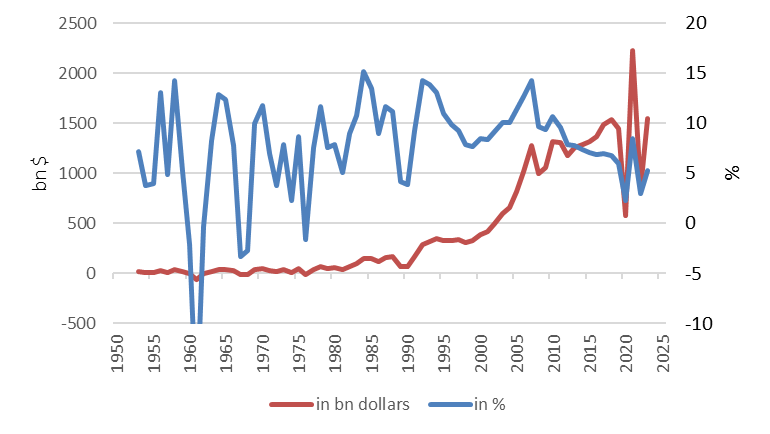
This distinction between growth rates and absolute growth is essential to understanding China's trajectory. The relative slowdown is largely mechanical. The larger an economy becomes, the harder it is to sustain high growth rates. The United States, Europe, and Japan have all experienced this normalization as they developed.
This means China's slowdown should be interpreted with caution. The country is not necessarily entering a phase of stagnation comparable to Japan in the 1990s. Rather, it is transitioning into a phase of economic maturity, characterized by lower growth rates but a much broader economic base.
Economic history shows that major powers always go through adjustment phases as they approach the global technological frontier. China is unlikely to be an exception.
Conclusion
For investors and international observers, the key question is not just China's growth rate, but the amount of wealth the economy continues to generate each year. As the economy becomes enormous, even more moderate growth represents a massive contribution to global output.
Falling below the 5% mark is therefore less a sign of decline than of normalization. China is no longer a high-growth emerging economy; it has become a giant economy whose even moderate expansion continues to reshape the global economic balance.
This article is a translation of a column originally published in French on Allnews.ch.
← All publications