American Monopoly: One for a Thousand, a Thousand for One
In 1989, an American in the top 0.1% owned as much as 500 households from the poorer half of the country. Today, it takes 1,100. In between: the rise of the internet, China's eruption into world trade, fifteen years of low interest rates and abundant liquidity, and now the artificial intelligence (AI) revolution. Four shocks, one single dynamic: a structural shift in the relative prices of labour and capital. The United States has measured the distribution of wealth since 1989, the year the Berlin Wall fell and liberalism prevailed — as if History itself had wanted to date the start of the game.
Monopoly
In 1989, a new round of global Monopoly begins. On the ruins of the USSR, amid the repression of Tiananmen, the construction of Europe and American supremacy, the players pass Go. Not all start on an equal footing: the players from the former communist bloc begin from scratch in a game whose rules they are still discovering, while the West simply carries on the game already under way. Let us follow the top-hatted token of the United States — and call it by its original name, Rich Uncle Pennybags. By 1989, he has been playing for a long time, owns hotels on the most prestigious squares and, above all, issues the currency on which every other player depends.
Rich Uncle Pennybags' finances are documented in detail by the Federal Reserve. In 1989, the total assets of American households amounted to $23.5 trillion at the prices of the day, and the richest 0.1% held roughly as much as the bottom 50% — the factor-of-500 gap mentioned above. Today, total assets have reached $194 trillion, but the wealth of the super-rich has been multiplied by 14, that of the less affluent half by only 6 — an inequality factor of more than 1,100.
How to get rich?
Work less, own capital. The share of wages in US GDP has fallen from 56.1% in 1989 to 51% today. Corporate profits captured slightly more than half of this 5.1-percentage-point decline; capital depreciation absorbed almost all the rest, while net taxes remained broadly stable.
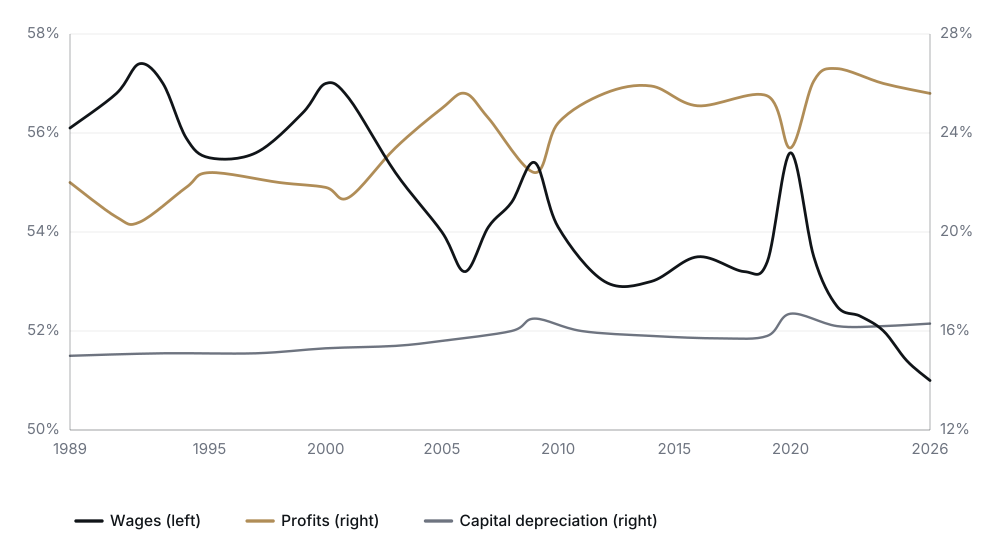
Two trends emerge. First, wages and profits move in mirror image, to the rhythm of the business cycle: the volatility of profits is counter-cyclical, allowing wages to keep being paid even in recessions. Second, the rise of depreciation since the late 1990s tells the story of an economy devoting a growing share of its income to replacing a capital stock that is ever larger and ever faster to become obsolete. The Chinese labour-supply shock of the 2000s weighed on wages and allowed American companies to lift their profits and modernise their productive capital. AI extends the movement: a data centre depreciates in a few years, where a factory used to last decades.
Real estate for the poor
The composition of wealth has also worked against those who depend on their wages to make ends meet. For the bottom 50%, the main asset — when there is one — is real estate, followed by consumer durables, which depreciate quickly. Unlike the wealthier classes, this half owns few equities and rarely a business, for acquiring such assets requires savings, a starting capital.
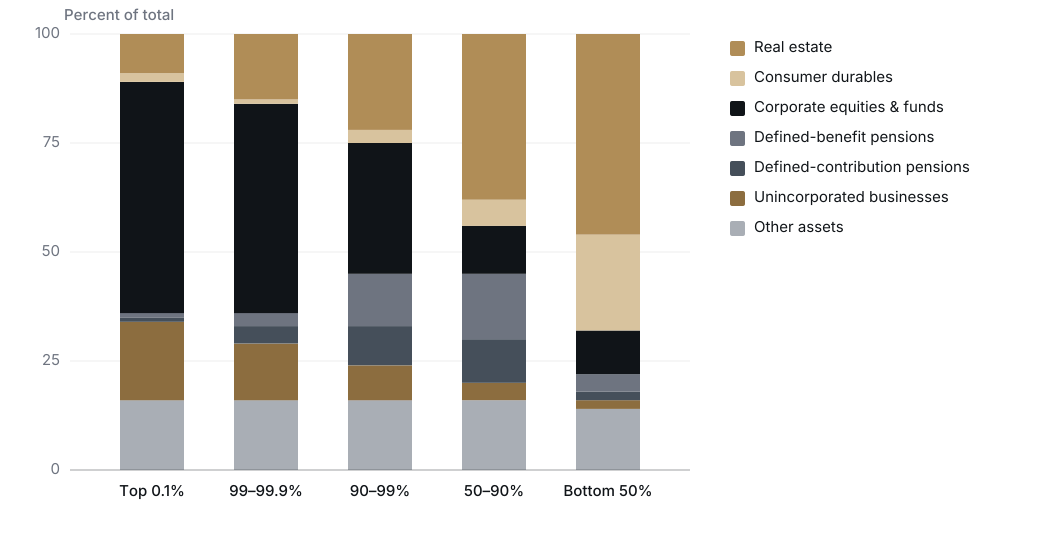
In 2007, the American housing market collapsed, triggering a global financial crisis and the massive impoverishment of half the population. Shut out of housing and then of the labour market, that half could not rebuild. The upper classes, by contrast, benefited from the monetary and fiscal policies that first and foremost revived equity markets. Covid would further extend this period of low rates and abundant liquidity so favourable to equities.
Our grandchildren
The latest shock is AI, which threatens to automate white-collar work before turning, with the help of robots, to every other profession. In 1930, John Maynard Keynes projected himself into the year 2030 in a famous essay, Economic Possibilities for our Grandchildren: progress would have reduced the need for labour so much that a fifteen-hour week would suffice, machines doing the work. He is also credited with the line "it is better to be roughly right than precisely wrong". Working fifteen hours a week within four years still seems utopian; that human labour should lose its value to AI is far less so.
Keynes imagined a happy future in which work became incidental. The statistics suggest instead that, as work becomes incidental, the future darkens for at least half of the American population. For the essay leaves one question unanswered: how are fifteen hours of work supposed to support a household? Keynes won his bet on production; he said nothing about distribution. Yet when more than half the population of a democracy is durably left behind, it voices its discontent first at the ballot box, then in the street. Taxing the super-rich, socialising corporate profits, universal income: one can feel History searching for a new direction.
Epilogue
Every game of Monopoly ends the same way: when one player concentrates almost all the wealth, the others give up before the end. To hold a monopoly on wealth is to win, but it is also to be the only one left playing, and that is worth nothing.
To restart the game, wealth must be redistributed. The board offers three options:
- wipe out the past and start over — that is revolution;
- the winner shares part of his wealth, voluntarily or not, and the game goes on — these are donation or taxation; or
- the bank issues new banknotes — this is monetisation, and the game is prolonged.
Investors will recognise their scenarios. The first is the tail risk no portfolio can truly hedge. The second — taxing capital, wealth and profits — would weigh on valuations. The third has a name, inflation and currency depreciation, and favours real assets.
While we wait to see which one prevails, the lesson of the board applies to the portfolio: you do not win at Monopoly with your salary, but with your properties. In an economy where wealth accrues to capital, owning capital — broadly, globally, patiently — remains the best way to stay in the game.
This article is a translation of a column originally published in French on Allnews.ch. Deutsche Version.
← All publications